
Landing Page: 7 Easy, Essential Checks
A landing page works best when its message matches the reason someone clicked. Plan one clear purpose, explain the offer honestly, and make the next step easy to understand. The page should support a decision without hiding important conditions behind a prominent button.
In this guide
A practical landing page example
A repair business shares a post about a particular service but sends visitors to a broad page covering everything. A focused page can help by continuing the same topic, answering the relevant questions, and offering an inquiry route that preserves that context.
1. Match the incoming message for landing page
Read the social post, email, or advertisement that sends people to the page. Keep the service and expectations consistent. If the promotion discusses one offer, do not make visitors search a general catalogue to find the details they expected.
2. Define a single main goal
Choose the most useful action for the audience and stage of the conversation. An initial inquiry may be more appropriate than demanding an immediate purchase. Explain what the visitor is submitting and what response they should expect without promising a turnaround you cannot support.
3. Explain the offer and boundaries for landing page
Describe the service, who it suits, and the information needed to assess a request. Include important exclusions and conditions in readable language. Clear scope helps visitors decide whether to continue and reduces inquiries built on assumptions the business cannot meet.
4. Use evidence that fits the topic
Show genuine examples relevant to the offer. Describe the business problem and work completed without inventing performance figures. If a testimonial is included, obtain permission and preserve its meaning. Generic praise is less useful than evidence that answers the visitor’s actual concern.
5. Keep the inquiry form proportionate for landing page
Ask for the information needed for the next step rather than collecting everything at once. Label fields clearly and explain optional details. Avoid requesting passwords, private documents, or sensitive information through an ordinary initial contact form.
6. Test the complete mobile journey
Use a phone to read the page and complete a labelled test inquiry. Check keyboard behaviour, error messages, and the confirmation state. Verify that the business receives the message; a successful-looking screen alone does not establish delivery.
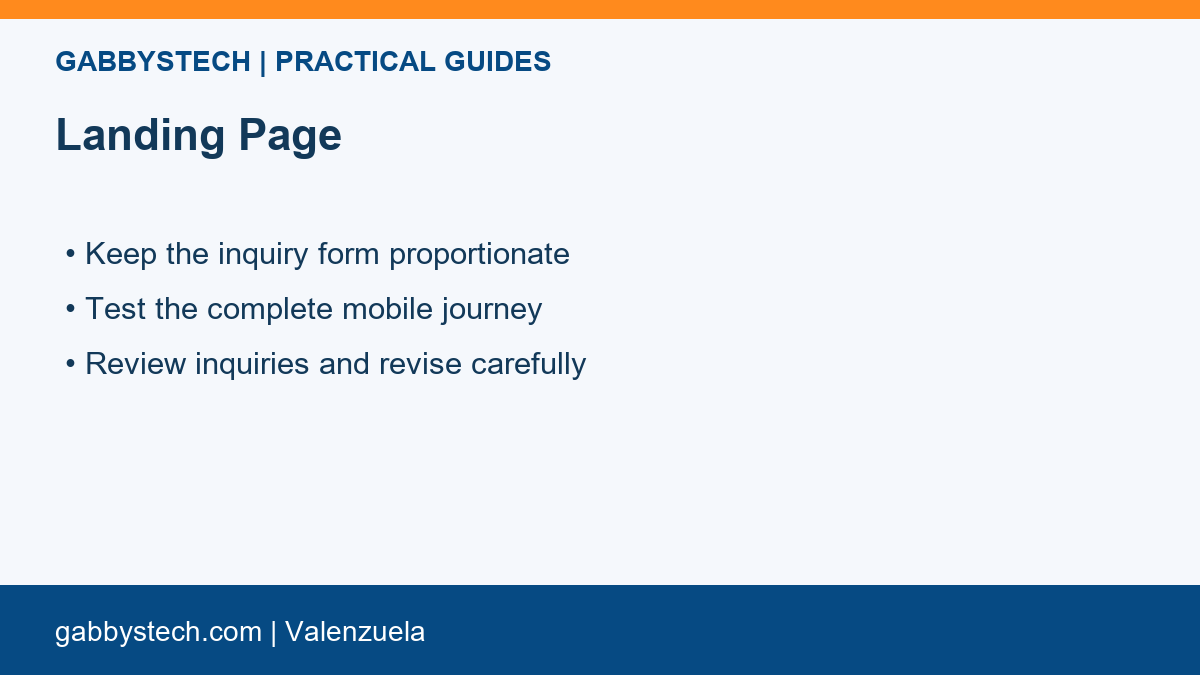
7. Review inquiries and revise carefully for landing page
Record recurring questions and points of confusion. Improve unclear wording before adding extra sections. When testing a change, keep the goal and comparison period clear. A landing page should evolve from evidence rather than repeated redesigns based only on personal preference.
Prepare a clear landing page inquiry
Collect the exact page address, the intended customer task, and a short description of the current difficulty. Separate what you observed from what you think caused it. A specific example such as a button leading to the wrong place is easier to investigate than a broad request to improve everything.
Keep a record of the current version and any recent content or design changes. Include the goal, the pages involved, and a practical deadline. Use sample information when demonstrating a form. Account passwords, recovery codes, and private customer records should stay out of public comments and ordinary inquiry forms.
Landing Page: a question worth asking
Does a focused page need to remove all useful navigation?
Not necessarily. Keep routes that help visitors understand the business, verify important information, or find relevant conditions. The aim is a clear main action, not trapping someone on a page. Balance focus with the information a reasonable customer needs.
Record the decision and the result
A useful landing page plan has a clear owner and a clear next step. Write down what will be checked, who will approve changes, and how the result will be verified. If the proposed work changes after review, ask for an updated explanation before additional work begins. Keep completed work separate from suggestions for later.
| Record | What to include |
|---|---|
| Starting point | Your model or page, main task, and specific symptom |
| Agreed scope | Checks, exclusions, proposed changes, and approval |
| Acceptance | The original task repeated and any remaining issue |
For related planning, read our guide to clear service pages and contact-form checks. Google’s SEO Starter Guide is an official reference for the broader search context. Use it alongside a review of the real customer journey rather than treating any single checklist as a guarantee.
Discuss landing page with GabbysTech
GabbysTech in Valenzuela can discuss your website goals and the information needed for a useful review. Send the page address, the customer task, and a short explanation of the problem through our website. Ask about scope, responsibilities, and applicable charges before approving work. A landing page checklist supports a clearer conversation; it does not guarantee a particular ranking, traffic level, or business outcome.